

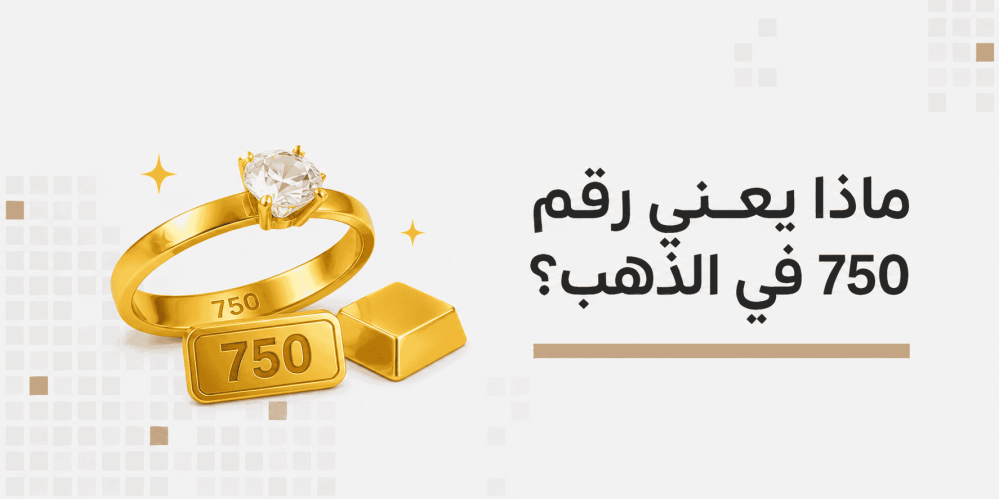
A comprehensive guide from Pearl Shine to understanding the 750 stamp, gold purity, and the difference between 750, 875, and 916. Have you found the number 750 engraved inside a ring or next to a chain clasp and wondered: Is this really gold, and what does it have to do with 18 karat? The number is very small, but it summarizes essential information about the piece; it does not describe the design, the country of manufacture, or the color of the gold, but rather the percentage of pure gold present in the alloy.
The number 750 means that every 1000 parts of the alloy contain 750 parts pure gold, or 75% gold. This percentage is equivalent to 18-karat gold. The remaining 25% consists of other metals added to the alloy to improve its properties or change its color. Therefore, 750 gold can be yellow, white, or rose gold while maintaining the same karat.
In this guide from Pearl Shine, we will not be satisfied with a short answer of one line, but we will understand the meaning of 750 in gold, how 18 karat turns into this number, what is the difference between 750, 875 and 916, whether 750 is genuine gold, whether the color affects the karat, and how to verify the piece's data before buying or selling.
What does the number 750 mean in gold in short?
The number 750 on gold means that the alloy contains 750 parts pure gold out of 1000 parts, meaning the gold content is 75%. This purity corresponds to 18 karat gold because 18 out of 24 parts are gold, while the remaining six parts are other metals within the alloy.
In simpler terms, the following relationship can be remembered: 750 = 75% gold = 18 karat. The World Gold Council confirms that 18 karat gold contains 75% gold and 25% other metals, and lists 750 among the common purity marks for 18 karat. Saudi regulatory guidelines also state that 18 karat gold jewelry corresponds to 750 parts per thousand of pure gold.
Key information about 750 gold
| Information | 750 gold | What does it mean in practice? |
| caliber | 18 karat | 18 parts of gold out of 24 parts |
| gold ratio | 75% | Approximately three-quarters of the ingot is pure gold. |
| purity number | 750 | 750 parts of gold out of 1000 |
| Other minerals | 25% | Its composition varies according to color and manufacturing |
| Possible colors | yellow, white, pink | The color does not change the fact that the purity is 75%. |
| Usage | Jewelry and various designs | Suitability also depends on design and construction. |
Why is 750 written instead of 18 on some gold pieces?
Because there are two common ways to express the purity of gold. The first method is the karat, in which the alloy is divided into 24 parts; if 18 parts of it are gold, we say that the piece is 18 karat. The second method expresses purity in parts per thousand, in which the gold content becomes 750 parts out of 1000, and therefore the number 750 appears on some jewelry instead of or next to 18.
The existence of the two systems does not mean that there are two different types of gold. The phrase "18 karat" and the number "750" describe the same level of purity in two different forms, and therefore two pieces of identical purity can have one labeled 18K in some markets and the other 750, depending on the marking system used in the country of manufacture or sale.
How does 18-karat gold turn into 750?
The calculation is straightforward: we divide 18 by 24 and get 0.75. When converted to a percentage, it becomes 75%, and when converted to thousandths, it becomes 750. Therefore, the number 750 is not a random trade name, but a mathematical expression of the percentage of gold in the alloy.
This rule is useful for understanding other numbers as well. For example, 21 ÷ 24 = 0.875, so 21 karat gold corresponds to the number 875. 22 ÷ 24 equals approximately 0.9167, so 22 karat gold appears as 916 or 917 in some systems.
Is 750 gold really 18 karat gold?
Yes. When the number 750 is used as a purity mark on a gold item, it indicates 18-karat gold with a purity of 75%. This correlation is supported by specialized sources such as the World Gold Council and the GIA, and is also reflected in Saudi Arabian regulatory guidelines for gold jewelry.
However, it's important to distinguish between the meaning of the number and verifying a piece of unknown origin. The number tells you what the purity is supposed to be, but verifying whether the metal actually matches this percentage depends on a reliable source, product data, hallmarks, and, if necessary, specialized testing.
Is 750 gold real gold or plated?
750 gold is genuine 18-karat gold when the piece itself is made from a gold alloy that matches the advertised purity. The presence of 25% other metals does not make the gold fake; the gold used in much jewelry is an alloy, not pure gold.
However, it's important to understand the difference between "18-karat gold" and "18-karat gold plated." The former means the piece itself is made of an alloy containing 75% gold, while the latter might mean another metal is coated with a layer of gold. Therefore, simply looking at the number or color isn't enough; read the full product description to confirm the item's purity.
What is 18-karat gold made of?
18-karat gold consists of 75% pure gold and 25% other metals or alloys. There is no single, mandatory composition for this 25%; manufacturers can use different compositions to achieve the desired color, hardness, and manufacturing properties, as long as the gold content matches the stated purity.
Some of the metals that may be used in alloys include copper, silver, zinc, palladium, and others. The World Gold Council provides typical examples of different alloys for 18-karat yellow, white, and rose gold, emphasizing that these are not the only possible alloys in the industry.
Is all 750 gold yellow in color?
No. This is one of the most important points that many buyers confuse: karat describes the percentage of gold, while color describes the alloy's appearance resulting from added metals and finishing. Therefore, you can find 18-karat gold in yellow, white, or rose gold, all of which have a purity of 750 if they contain 75% gold.
| 18-karat gold color | gold ratio | What makes the difference in color? | Important note |
| yellow gold | 75% | Balance of added minerals while preserving the golden color | The grade may vary slightly between one factory and another. |
| white gold | 75% | Using white-looking metals, and rhodium plating may be used. | The color white does not necessarily mean the piece is silver. |
| rose gold | 75% | The increased role of copper within the alloy components | The pink color does not change the caliber |
Is 750 white gold real gold?
Yes, if the piece is actually made of 18-karat white gold. White gold isn't simply gold-plated silver; it's a gold alloy that can contain up to 75% gold, along with other metals that give it a white appearance. Some pieces may also be rhodium-plated to enhance the whiteness and shine.
This highlights the importance of not using color as a test of purity. A white piece could be gold, platinum, silver, or another metal; therefore, the purity, description, hallmark, and examination are the most important information, not just visual impression.
Is 750 rose gold real gold?
Yes. 18-karat rose gold also contains 75% gold when it is 18-karat, but the remaining 25% is often made up of copper and other metals in proportions that give it its pink color. The GIA explains that the varying proportions of these added metals are what allow for the production of different gold colors while maintaining the specified karat.
What is the difference between 750, 875 and 916?
The three numbers represent different levels of gold purity. 750 means 18 karat, 875 means 21 karat, and 916 is approximately 22 karat. The higher the number, the greater the percentage of pure gold in the alloy, but higher purity alone does not necessarily mean that a higher karat is the best choice for every design or use.
| Comparison point | 750 | 875 | 916 |
| caliber | 18 karat | 21 caliber | 22 caliber |
| gold ratio | 75% | 87.5% | Approximately 91.6% |
| Other minerals | 25% | 12.5% | Approximately 8.4% |
| What does it describe? | 18-karat purity | 21-karat purity | 22-carat purity |
| Is it real gold? | Yes, if it matches the advertised standard. | Yes, if it matches the advertised standard. | Yes, if it matches the advertised standard. |
Is 875 better than 750 because the gold content is higher?
If the question is only about the percentage of pure gold, then 875 is purer than 750; 21 karat contains 87.5% gold compared to 75% in 18 karat. But if the question is about the "best piece of jewelry", there is no single answer that suits everyone, because the choice is influenced by the design, weight, color, use, budget and method of manufacture.
One person might prefer a higher gold content, while another might prefer a specific design available in 18-karat, white, or rose gold. Therefore, it's best to separate the question of purity from the question of suitability for everyday use.
Is the 750 gold suitable for everyday use?
18-karat gold can be very suitable for many everyday jewelry pieces, but karat isn't the only factor that determines durability. A very thin, hollow, or delicately detailed piece may require more care, even if it's 18 karat, while a solid piece with a robust design may be more suitable for frequent wear.
When choosing a ring, bracelet, or necklace for everyday use, look at the thickness of the piece, the way the links are constructed, the type of clasp, the presence of prominent stones, and the nature of your daily activity. Do not base your decision solely on the carat number.
Does 750 gold change color?
18-karat gold contains 75% gold and 25% other metals, so its surface appearance can change over time due to friction, the accumulation of toiletries, perfumes, oils, dirt, and the nature of the other metals in the alloy. In white gold, the appearance may also change as the rhodium plating, if present, wears away, making the original alloy's color more apparent.
However, a faded piece or a change in its shine does not automatically mean it is fake. Proper cleaning and professional inspection if there is an unusual change are better than relying on a quick visual inference.
Does the number 750 mean that the gold is Italian?
No. The number 750 indicates purity, not country of origin. You might find 18-karat pieces made in Italy, Saudi Arabia, or other countries bearing the same number. Therefore, the term "Italian gold" usually describes the country of origin or the manufacturing style and design, while 750 tells you that the gold content in the alloy is 75%.
This is an important point when comparing products; don't let the country of origin replace knowledge of the purity, weight, and manufacturing process. Two pieces from different countries might both be 750 purity, but they could differ in design, workmanship, color, and finish.
Where is the number 750 on the gold piece?
The placement of the number varies depending on the type of item. It may be inside a ring band, near the clasp of a chain or necklace, on a small part of a bracelet or earring, or on a small plaque. The hallmark may become difficult to read after years of use or due to its small size.
If you cannot read the number, do not scratch the piece or attempt to deepen the engraving yourself. For important or valuable pieces, a jeweler or specialist can examine the markings and the metal using appropriate methods.
Is the presence of a 750 stamp sufficient to confirm that the gold is genuine?
The hallmark is important information, but it's not a single, definitive test for every piece of unknown origin. The hallmark tells you about the declared purity, but actually verifying the metal may require looking at the piece's provenance, the invoice, and other markings, or having a professional examiner test it if there are reasons to doubt.
The World Gold Council explains that hallmarking systems around the world may include a purity mark and a mark from the assaying body or manufacturer, and that hallmarking requirements vary from country to country. Therefore, reading a correct piece of gold means understanding its set of specifications, not just a single number.
What is the difference between the number 750, the stamp, and the manufacturer's mark?
The number 750 is a purity mark; it describes the amount of gold in the alloy. The manufacturer's mark is associated with the manufacturer or the entity responsible for the piece. Other marks or hallmarks may be present depending on the system used in the market. Therefore, when you see several symbols on a piece, do not assume that they all represent the karat.
What does 750 mean in gold in Saudi Arabia?
In Saudi Arabia, 750 is considered a standard for gold jewelry and is equivalent to 18 karats. Furthermore, regulatory amendments implemented on October 11, 2025, strengthened disclosure requirements for precious metal products, including the requirement to state the type, weight, karat, and price of the product according to its nature when advertising it. This makes knowing the karat and weight essential.
Reading the product information before buying, especially in online stores.
Therefore, when buying an 18-karat piece, do not rely solely on the product image or the word "gold"; check the description of the karat, weight, price, and details of the piece, and keep the invoice for future reference.
How do you calculate the amount of pure gold in a 750 piece?
If you know the weight of gold included in the piece, you can theoretically calculate the amount of pure gold by multiplying the weight by 0.75. For example, if the weight of the gold is 20 grams, the theoretical amount of pure gold is 15 grams: 20 x 0.75 = 15.
A piece of 18-karat gold weighing 10 grams theoretically contains 7.5 grams of pure gold. This calculation explains the metal content but does not represent the final price of the jewelry, as the price may include labor, design, gemstones, taxes or fees, and other commercial factors.
Is 750 gold cheaper than 875?
If you compare equal amounts of metal at the same moment, 18-karat gold has a lower gold content than 21-karat gold, so the raw gold of the same weight is usually less valuable. However, the price of a finished piece of jewelry is not determined by karat alone; an 18-karat piece might be heavier, have more intricate workmanship, contain stones, or feature a more complex design, thus making it more expensive than a 21-karat piece.
Therefore, don't use the "higher karat always means more expensive" rule when comparing products. Compare weight, workmanship, design, stones, and karat together.
Is 750 a good value for resale?
18-karat gold contains 75% gold, and therefore its value is tied to its weight and the price of gold at the time of sale. However, the resale price is not necessarily equal to the price you paid when you bought the piece new, because the purchase price may include workmanship, design, gemstones, and other elements that are not recalculated in the same way when reselling.
If you are considering reselling, separate the value of the gold content from the price of the jewelry as a new item. For pieces with hallmarks, stones, or design value, there may be an independent resale value that warrants evaluation before treating them solely as melted gold.
Does 750 mean better gold for rings than 21 karat gold?
A definitive judgment cannot be made. While some intricate or embellished ring designs may be made with 18-karat gold, the ring's quality and fit depend on the design, the thickness of the metal, the setting of the stones, and the craftsmanship, not just the karat number. Similarly, a buyer might prefer 21-karat gold due to its higher gold content or their preferred color.
The most useful question is: Which caliber and design suits my usage style? Not just: Which higher number?
How do you read a 750 gold piece before buying it?
Before making a decision, start with the karat and then move on to the rest of the details. Make sure the product is clearly described as 18-karat or 750 gold, then check the weight and whether it includes stones or other components. Read the description of the color, size, and manufacturing method, if mentioned.
Next, compare the price with the weight, workmanship, and design, and don't forget the invoice and store details. Accurately assessing a piece of gold combines purity, weight, and the product's characteristics; it doesn't rely solely on the piece's appearance.
Common mistakes when understanding the number 750 in gold
The belief that 750 means that the piece contains 750 grams of gold is incorrect; it is an expression of purity in parts per thousand.
The belief that 18-karat gold is not genuine gold because it is not 24 karats is incorrect; it is a genuine gold alloy with a purity of 75% if it matches the advertised karat.
Color is considered an indicator of purity; while 750 gold can be yellow, white, or rose gold.
The belief that 750 automatically means the piece is Italian is incorrect; the number describes purity, not country of origin.
Using the seal alone as the final test of authenticity in an item of unknown origin, instead of looking at all of its data and examining it when necessary.
Comparing prices based on carat alone, excluding weight, workmanship, stones, and design.
Frequently asked questions about the number 750 in gold
What does the number 750 on gold mean?
This means that the alloy contains 750 parts of pure gold out of 1000, or 75% gold, which is equivalent to 18 carats.
750 is gold of what carat?
The number 750 corresponds to 18-karat gold.
Is 750 real gold?
Yes, when the piece is actually made of a gold alloy that matches 18 karat. The presence of 25% other metals is a natural part of the alloy's composition.
Is 750 gold or silver?
If the number 750 is used as a purity mark on a gold item, it means 18-karat gold. However, the type of an unknown metal cannot be determined from a single number without context or examination.
What is the percentage of gold in 750?
75% of the alloy is gold, while other metals make up 25%.
What is the difference between 750 and 875?
750 means 18 karat gold with 75% gold, while 875 means 21 karat gold with 87.5% gold.
What is the difference between 750 and 916?
750 corresponds to 18 karat gold, while 916 corresponds to approximately 22 karat gold and a higher gold content.
Is 750 white gold?
It may be. 750 only specifies purity; 18-karat gold can be yellow, white, or rose gold.
Is white gold 750 silver?
No. 18-karat white gold can hold 750 because it contains 75% gold. The white color alone does not determine the type of metal.
Does 750 gold change color?
The surface finish or luster may change with use and environmental factors, and white gold may require re-rhodium plating if the piece is rhodium-plated. This change does not automatically mean the gold is fake.
Does the number 750 indicate the country of manufacture?
No. The number indicates purity and not whether the gold is Italian, Saudi, or from a specific country.
Where is the 750 seal located?
It may be found inside a ring, near the clasp of a chain, or on a small part of a bracelet or earring. The position varies according to the design and the manufacturer.
Is having 750 enough to identify genuine gold?
It is an indicator of declared purity, but it is not a substitute for a reliable source, clear data, or expert examination when there is doubt.
Is 750 less valuable than 875?
For the same weight and considering only the gold content, 875 contains more gold. However, the final price of the jewelry is also affected by weight, craftsmanship, design, and gemstones.
Is 18 karat gold suitable for everyday use?
It can be suitable for many pieces, but durability also depends on the thickness and construction of the piece, the type of lock, the presence of stones, and the nature of the use.
750 is no longer a mysterious number
Once you understand the meaning of the number 750 in gold, it becomes easier to read many jewelry specifications. The number doesn't tell you the size, country of origin, or color of the piece; rather, it tells you something very specific: that the alloy in question is 75% gold, or 18 karats.
This information is important, but it's not the only thing you need to make a good buying decision. Always combine it with the weight, type of piece, manufacturing process, color, any stones, labor costs, and invoice. The clearer the product details, the easier it is to compare pieces based on their actual condition, not just their appearance.
In the Pearl's Shine, we see that knowing gold is part of the experience of choosing it; because understanding the numbers, carats, and hallmarks helps you know what you are actually buying, and makes choosing the right piece for your taste and use clearer.